
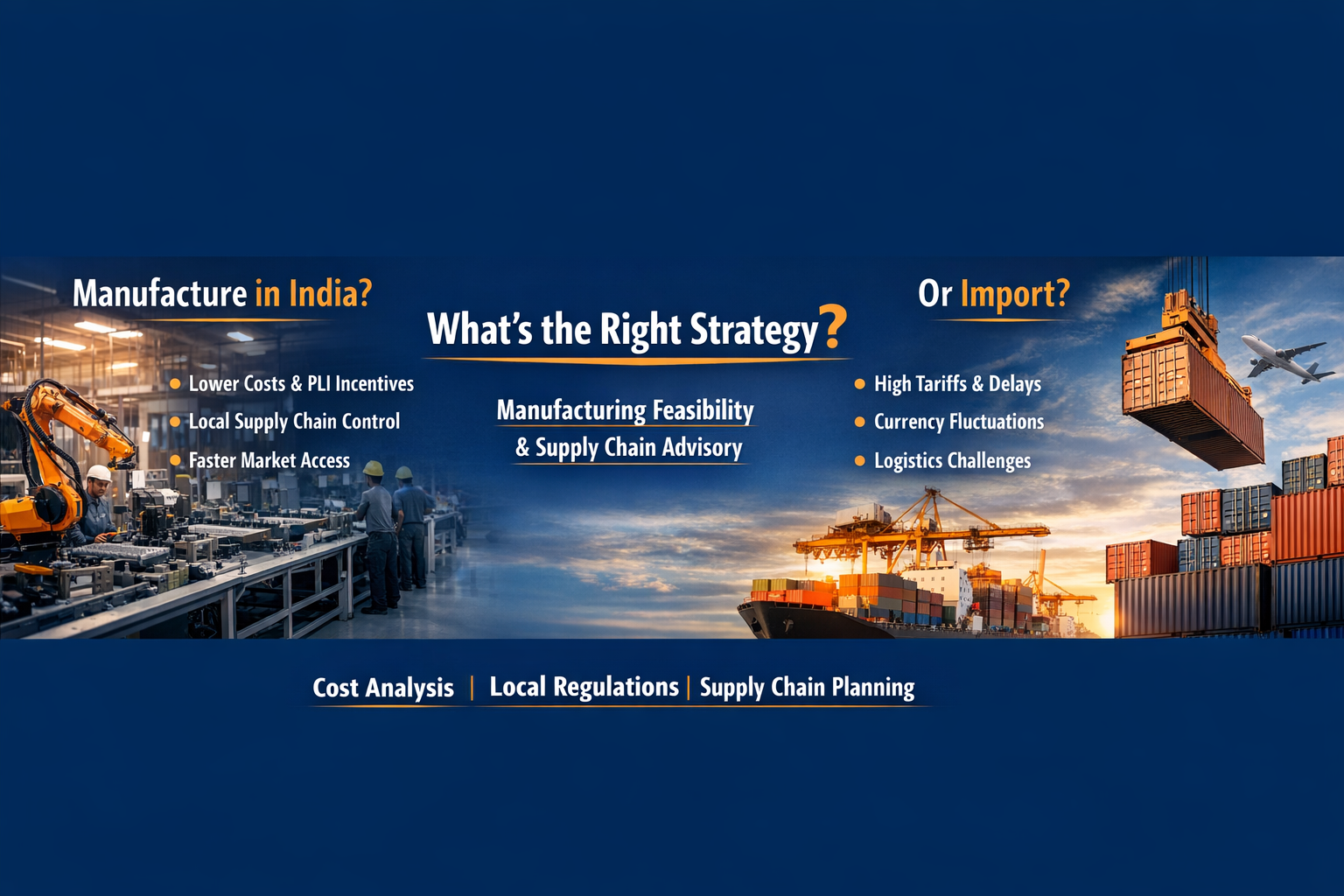
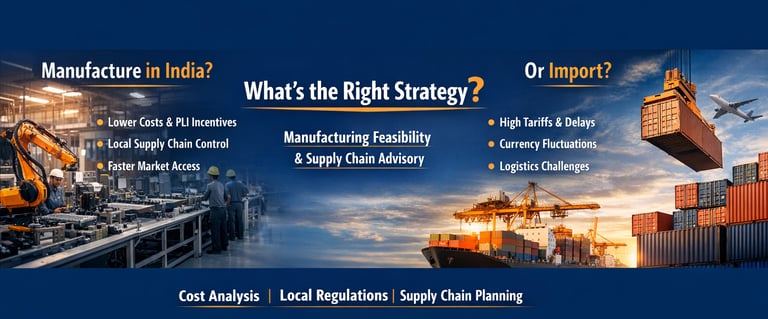
For many global companies eyeing India’s burgeoning economy, one of the toughest strategic decisions isn’t whetherthere’s demand—but how to best serve it. Should you manufacture in India or continue importing your products? The answer is far more complex than it appears, and getting it wrong can jeopardize timelines, profitability, compliance, and long-term competitiveness.
India’s manufacturing landscape is growing rapidly. As of 2025, manufacturing contributes around 15–17 % of India’s GDP, and government initiatives such as Make in India, Production Linked Incentive (PLI) schemes, and the National Manufacturing Mission are pushing for a target of 20–25 % of GDP by 2030. India’s manufacturing output is rising, backed by rising merchandise exports (over US$ 254 billion in FY26) and significant investments in core sectors like electronics, automotive, pharmaceuticals, and defence.
Nevertheless, global brands often misread this progress. On one hand, India is among the world’s fastest-growing manufacturing destinations, producing millions of smartphone units locally—up from around 15 million in early 2024 to nearly 22.9 million units exported in the first half of 2025 alone. Major global players have scaled production in India thanks to incentives and localized supply chains. On the other hand, despite rising output and export momentum, India still relies heavily on imports for key intermediate goods and components—especially in high-tech and capital-intensive sectors.
This paradox creates a strategic dilemma. Importing finished products may appear easier, require lower upfront capital, and enable faster initial market presence. However, it subjects brands to import duties, currency fluctuations, longer lead times, and weaker control over service, logistics, and customer experience. It also limits eligibility for government incentives and market support programs that can dramatically reduce costs and improve competitiveness.
Conversely, manufacturing in India can unlock deeper cost advantages, preferential market access, strong supply-chain positioning, and brand goodwill—especially under initiatives like PLI, which have unlocked billions in incentives for sectors including electronics, pharmaceuticals, and EV components. But local manufacturing also comes with challenges: land and utility costs, complex approvals, workforce sourcing, localized supply networks, and coordination across multiple state-level regulations.
This is where many global brands get the decision wrong—they underestimate the feasibility and supply chain complexity before diving into either strategy. Without a detailed Manufacturing Feasibility Study, they miss critical insights into cost structures, local input availability, compliance timelines, operational scalability, and capital requirements. Without deep Supply Chain Advisory, they risk fragile logistics networks, inefficient partner selection, and inventory bottlenecks.
At Strategix India Consulting, we help global companies evaluate this decision with precision. Our Manufacturing Feasibility assessments combine market demand, cost modelling, regulatory mapping, and site evaluation to determine whether local production is viable. We pair this with Supply Chain Advisory that designs optimized supplier networks, identifies partners, and builds resilient logistics strategies tailored for India’s fragmented market.
Local manufacturing is not inherently better than importing—and importing is not inherently easier or cheaper in India. The right choice depends on your product category, cost structure, pricing strategy, channel plan, regulatory requirements, and scale ambitions. A ‘gut feel’ or generic global playbook is no substitute for robust feasibility analysis coupled with real-world supply chain planning.
For global brands looking to navigate India’s complexity, Strategix India Consulting stands as a trusted partner, transforming strategic ambiguity into clarity—and helping decisions that drive both short-term entry and long-term scale.
📩 Let’s discuss your India market entry strategy
Let’s build your India story the right way.
🔁 If this resonated, share it with someone thinking about India.
👍 Follow Strategix India Consulting for insights on growth, market entry, and scale.